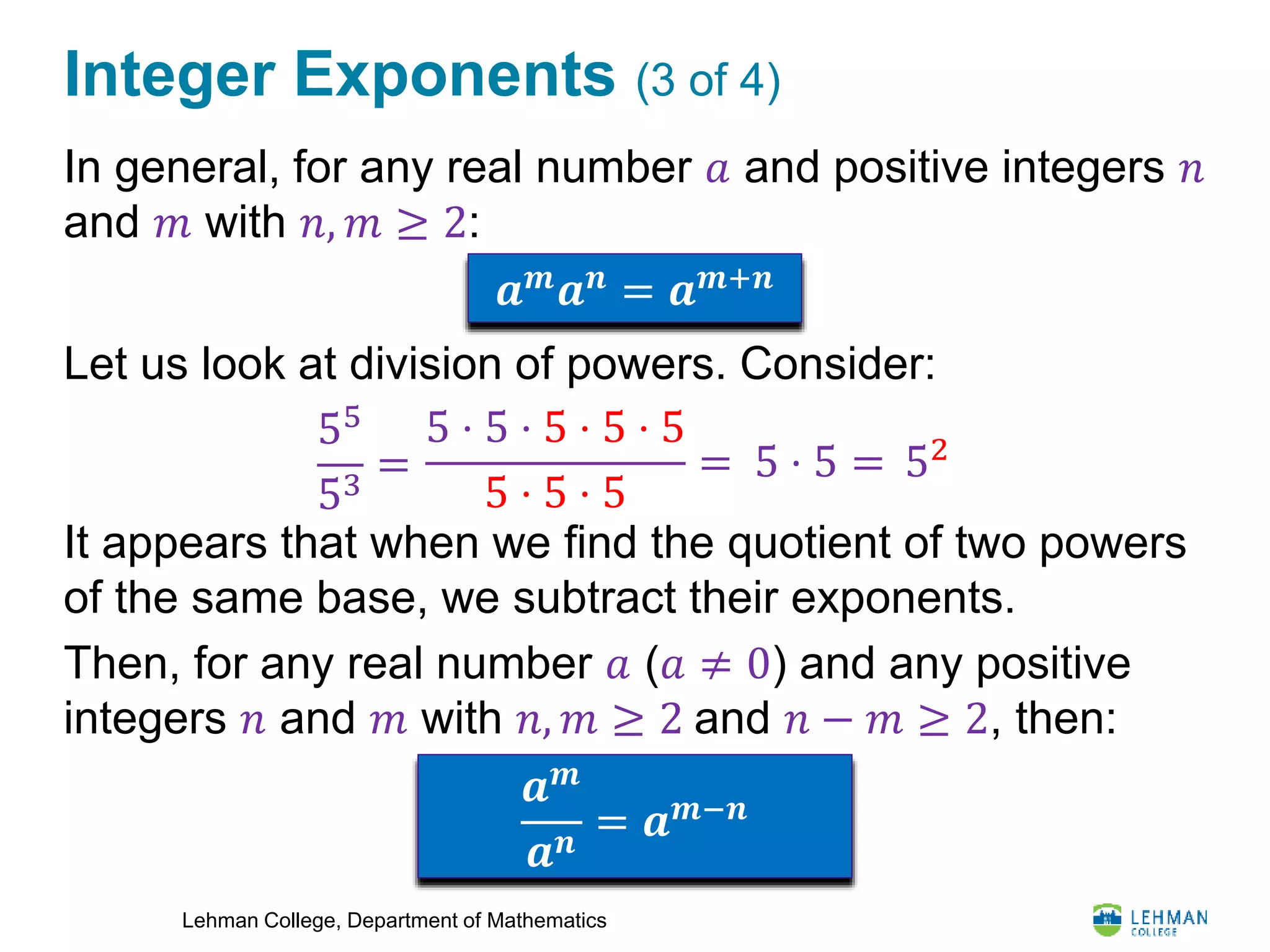

Understanding and effectively using exponential notation is a fundamental skill in mathematics and science. It allows us to express very large or very small numbers in a more manageable form. This notation is particularly useful in fields such as physics, engineering, and computer science, where numbers can quickly become unwieldy. In this post, we will delve into the concept of exponential notation, its applications, and how to perform operations with it. We will also explore the process of Adding Exponential Notation and provide practical examples to illustrate these concepts.
What is Exponential Notation?
Exponential notation is a way of writing numbers that are powers of 10. It is expressed in the form a × 10n, where a is a number between 1 and 10 (inclusive), and n is an integer. The value of n determines whether the number is large or small:
- If n is positive, the number is greater than 1.
- If n is negative, the number is less than 1.
For example, the number 500 can be written as 5 × 10², and the number 0.003 can be written as 3 × 10⁻³.
Why Use Exponential Notation?
Exponential notation simplifies the representation of very large or very small numbers. It makes calculations easier and reduces the likelihood of errors. Here are some key reasons why exponential notation is useful:
- Simplicity: It reduces the number of digits needed to write large or small numbers.
- Precision: It allows for more precise calculations, especially in scientific and engineering contexts.
- Consistency: It provides a standardized way to express numbers, making it easier to compare and manipulate them.
Basic Operations with Exponential Notation
Performing basic operations with exponential notation involves understanding how to add, subtract, multiply, and divide numbers in this form. Let’s start with multiplication and division, as they are straightforward.
Multiplication and Division
When multiplying or dividing numbers in exponential notation, you simply add or subtract the exponents:
- Multiplication: (a × 10m) × (b × 10n) = (a × b) × 10m+n
- Division: (a × 10m) ÷ (b × 10n) = (a ÷ b) × 10m-n
For example, (2 × 103) × (3 × 102) = 6 × 10⁵, and (4 × 10⁴) ÷ (2 × 10²) = 2 × 10².
Adding Exponential Notation
Adding numbers in exponential notation can be a bit more complex, especially if the exponents are different. The key is to ensure that the exponents are the same before adding the coefficients. Here are the steps to add numbers in exponential notation:
- Identify the numbers to be added and their exponents.
- If the exponents are the same, add the coefficients and keep the exponent the same.
- If the exponents are different, convert one or both numbers so that the exponents are the same.
- Add the coefficients and keep the common exponent.
For example, to add 3 × 10² and 4 × 10², you simply add the coefficients: 3 + 4 = 7. So, 3 × 10² + 4 × 102 = 7 × 10².
If the exponents are different, such as adding 3 × 10² and 4 × 10³, you need to convert one of the numbers:
- Convert 3 × 10² to 0.3 × 10³.
- Now add 0.3 × 10³ and 4 × 10³ to get 4.3 × 10³.
This process ensures that the exponents are the same before adding the coefficients.
💡 Note: When adding numbers with different exponents, it's important to convert the smaller number to have the same exponent as the larger number. This ensures accuracy in the addition process.
Practical Examples of Adding Exponential Notation
Let’s look at some practical examples to solidify our understanding of adding exponential notation.
Example 1: Adding Numbers with the Same Exponent
Add 2 × 10⁴ and 3 × 10⁴:
- Both numbers have the same exponent, 4.
- Add the coefficients: 2 + 3 = 5.
- The result is 5 × 10⁴.
Example 2: Adding Numbers with Different Exponents
Add 5 × 10³ and 2 × 10²:
- Convert 2 × 10² to 0.2 × 10³.
- Now add 5 × 10³ and 0.2 × 10³ to get 5.2 × 10³.
Example 3: Adding Multiple Numbers with Different Exponents
Add 1 × 10⁵, 2 × 10⁴, and 3 × 10³:
- Convert 2 × 10⁴ to 0.2 × 10⁵ and 3 × 10³ to 0.03 × 10⁵.
- Now add 1 × 10⁵, 0.2 × 10⁵, and 0.03 × 10⁵ to get 1.23 × 10⁵.
Common Mistakes to Avoid
When working with exponential notation, it’s easy to make mistakes, especially when adding numbers with different exponents. Here are some common pitfalls to avoid:
- Incorrect Conversion: Ensure that you correctly convert numbers to have the same exponent before adding.
- Forgetting to Add Coefficients: Remember to add the coefficients after converting the exponents.
- Ignoring Significant Figures: Pay attention to the number of significant figures in your calculations to maintain accuracy.
Applications of Exponential Notation
Exponential notation is widely used in various fields. Here are some key applications:
Science and Engineering
In science and engineering, exponential notation is used to express measurements, constants, and calculations. For example:
- The speed of light is approximately 3 × 10⁸ meters per second.
- The charge of an electron is approximately 1.6 × 10⁻¹⁹ coulombs.
Computer Science
In computer science, exponential notation is used to represent large numbers, such as memory sizes and processing speeds. For example:
- 1 gigabyte (GB) is 1 × 109 bytes.
- 1 terabyte (TB) is 1 × 1012 bytes.
Economics and Finance
In economics and finance, exponential notation is used to express large sums of money and economic indicators. For example:
- The national debt of a country might be expressed in trillions of dollars, such as 2 × 10¹² dollars.
- Stock prices and market indices often use exponential notation to represent large values.
Conclusion
Exponential notation is a powerful tool for expressing and manipulating very large or very small numbers. It simplifies calculations and reduces errors, making it indispensable in fields such as science, engineering, and computer science. Understanding how to perform operations with exponential notation, including Adding Exponential Notation, is crucial for accurate and efficient calculations. By following the steps and examples provided, you can master the use of exponential notation and apply it confidently in various contexts.
Related Terms:
- exponential notation with positive exponents
- exponential notation calculator free
- what does exponential notation mean
- exponential notation chart
- write using exponential notation
- how to solve exponential notation