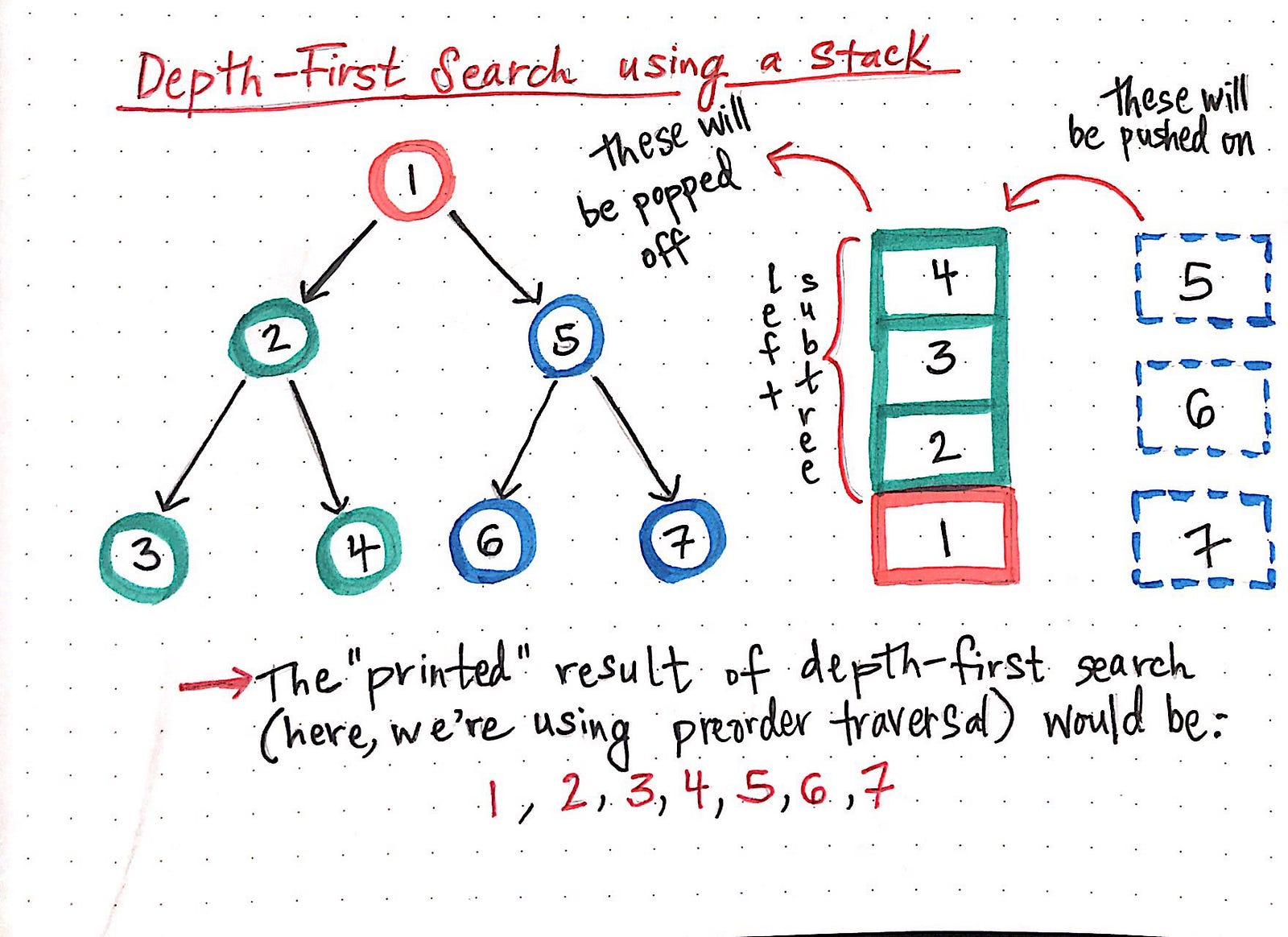

Depth First Search (DFS) is a fundamental algorithm in computer science, widely used for traversing or searching tree or graph data structures. It explores as far as possible along each branch before backtracking. This algorithm is particularly useful in scenarios where the goal is to find a path or explore all possible solutions. In this post, we will delve into the intricacies of Depth First Search, focusing on its implementation in Python. We will cover the basic concepts, different approaches to implementing DFS in Python, and practical examples to illustrate its usage.
Understanding Depth First Search
Depth First Search is an algorithm for traversing or searching tree or graph data structures. The algorithm starts at the root (selecting some arbitrary node as the root in the case of a graph) and explores as far as possible along each branch before backtracking. This means that it will go deep into one branch before exploring other branches.
There are two main ways to implement DFS:
- Recursive DFS
- Iterative DFS
Recursive Depth First Search Python
The recursive approach to DFS is straightforward and easy to understand. It uses the system stack to keep track of the nodes to be explored. Here is a simple implementation of recursive DFS in Python:
def recursive_dfs(graph, start, visited=None):
    if visited is None:
        visited = set()
    visited.add(start)
    print(start)

    for next in graph[start] - visited:
        recursive_dfs(graph, next, visited)
    return visited

# Example usage
graph = {
    'A': {'B', 'C'},
    'B': {'A', 'D', 'E'},
    'C': {'A', 'F'},
    'D': {'B'},
    'E': {'B', 'F'},
    'F': {'C', 'E'}
}

recursive_dfs(graph, 'A')
In this implementation, the recursive_dfs function takes a graph, a starting node, and a set of visited nodes. It marks the current node as visited, prints it, and then recursively calls itself for all unvisited adjacent nodes.
💡 Note: The recursive approach is simple but can lead to a stack overflow for very deep graphs due to the maximum recursion depth limit in Python.
Iterative Depth First Search Python
The iterative approach to DFS uses an explicit stack to keep track of the nodes to be explored. This method avoids the limitations of recursion and is more suitable for deep graphs. Here is an implementation of iterative DFS in Python:
def iterative_dfs(graph, start):
    visited = set()
    stack = [start]

    while stack:
        vertex = stack.pop()
        if vertex not in visited:
            visited.add(vertex)
            print(vertex)
            stack.extend(graph[vertex] - visited)

    return visited

# Example usage
graph = {
    'A': {'B', 'C'},
    'B': {'A', 'D', 'E'},
    'C': {'A', 'F'},
    'D': {'B'},
    'E': {'B', 'F'},
    'F': {'C', 'E'}
}

iterative_dfs(graph, 'A')
In this implementation, the iterative_dfs function initializes a stack with the starting node and a set to keep track of visited nodes. It then enters a loop where it pops a node from the stack, marks it as visited, prints it, and pushes all unvisited adjacent nodes onto the stack.
💡 Note: The iterative approach is more memory-efficient for deep graphs and avoids the risk of stack overflow.
Applications of Depth First Search
Depth First Search has a wide range of applications in various fields. Some of the most common applications include:
- Pathfinding: DFS can be used to find a path between two nodes in a graph.
- Cycle Detection: DFS can detect cycles in a graph, which is useful in various algorithms and data structures.
- Topological Sorting: DFS is used in topological sorting of Directed Acyclic Graphs (DAGs).
- Connected Components: DFS can be used to find all connected components in a graph.
- Maze Solving: DFS is commonly used to solve mazes by exploring all possible paths.
Depth First Search in Graphs
When dealing with graphs, DFS can be used to explore all nodes and edges. Here is an example of how to implement DFS for a graph represented as an adjacency list:
def dfs_graph(graph, start):
    visited = set()
    stack = [start]

    while stack:
        vertex = stack.pop()
        if vertex not in visited:
            visited.add(vertex)
            print(vertex)
            stack.extend(graph[vertex] - visited)

    return visited

# Example usage
graph = {
    'A': ['B', 'C'],
    'B': ['A', 'D', 'E'],
    'C': ['A', 'F'],
    'D': ['B'],
    'E': ['B', 'F'],
    'F': ['C', 'E']
}

dfs_graph(graph, 'A')
In this example, the graph is represented as an adjacency list, where each node points to a list of its adjacent nodes. The DFS function explores all nodes and edges in the graph, printing each node as it is visited.
Depth First Search in Trees
DFS is also commonly used to traverse trees. Here is an example of how to implement DFS for a binary tree:
class TreeNode:
    def __init__(self, value=0, left=None, right=None):
        self.value = value
        self.left = left
        self.right = right

def dfs_tree(root):
    if root is None:
        return
    print(root.value)
    dfs_tree(root.left)
    dfs_tree(root.right)

# Example usage
root = TreeNode(1)
root.left = TreeNode(2)
root.right = TreeNode(3)
root.left.left = TreeNode(4)
root.left.right = TreeNode(5)

dfs_tree(root)
In this implementation, the dfs_tree function recursively visits the root node, then the left subtree, and finally the right subtree. This ensures that all nodes in the tree are visited in a depth-first manner.
💡 Note: The order of visiting left and right subtrees can be changed to perform different types of tree traversals, such as pre-order, in-order, and post-order.
Optimizing Depth First Search
While DFS is a powerful algorithm, there are ways to optimize it for better performance. Some optimization techniques include:
- Pruning: If the goal is to find a specific path or solution, pruning can be used to cut off branches that do not lead to a solution, reducing the number of nodes explored.
- Memoization: Storing the results of expensive function calls and reusing them when the same inputs occur again can significantly speed up the algorithm.
- Early Termination: If the goal is found during the search, the algorithm can terminate early, saving time and resources.
Depth First Search vs. Breadth First Search
Depth First Search and Breadth First Search (BFS) are two fundamental graph traversal algorithms. While DFS explores as far as possible along each branch before backtracking, BFS explores all neighbors at the present depth prior to moving on to nodes at the next depth level. Here is a comparison of the two algorithms:
| Aspect | Depth First Search | Breadth First Search |
|---|---|---|
| Exploration Order | Deep into one branch before backtracking | All neighbors at the present depth level |
| Memory Usage | Lower memory usage for deep graphs | Higher memory usage for wide graphs |
| Use Cases | Pathfinding, cycle detection, maze solving | Shortest path in unweighted graphs, level-order traversal |
Choosing between DFS and BFS depends on the specific requirements of the problem at hand. DFS is generally more suitable for deep graphs, while BFS is better for wide graphs or when the shortest path is required.
In conclusion, Depth First Search is a versatile and powerful algorithm with a wide range of applications. Whether implemented recursively or iteratively, DFS provides an efficient way to traverse and search tree and graph data structures. By understanding the intricacies of DFS and its various implementations, developers can leverage this algorithm to solve complex problems in computer science and beyond.
Related Terms:
- depth first search using python
- breadth first search python
- depth first search implementation python
- depth first search python algorithm
- python graph depth first search
- depth first search algorithm