
Understanding the nuances of sampling methods is crucial for anyone involved in data analysis or research. One of the key distinctions in sampling is between probability and non-probability sampling methods. While probability sampling methods involve random selection and ensure that every member of the population has an equal chance of being selected, non-probability sampling methods do not. This post will delve into the intricacies of non-probability sampling, providing a comprehensive overview, examples, and practical applications.
Understanding Non-Probability Sampling
Non-probability sampling is a method where the samples are gathered in a process that does not give all the individuals in the population equal chances of being selected. This type of sampling is often used when the population is large, diverse, or difficult to access. Non-probability sampling methods are generally quicker and less expensive than probability methods, making them a popular choice for preliminary research or when resources are limited.
Types of Non-Probability Sampling
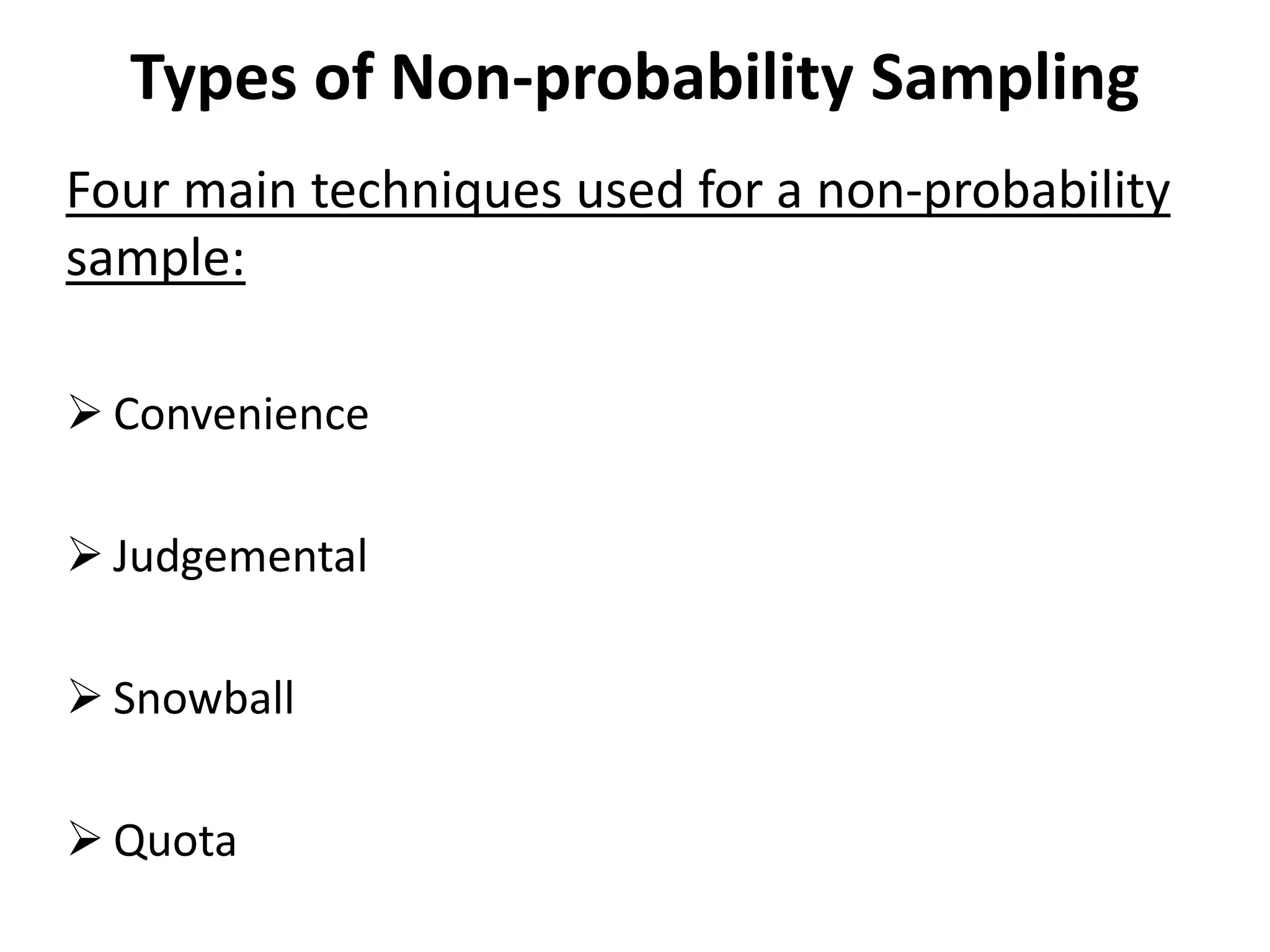
There are several types of non-probability sampling methods, each with its own advantages and limitations. The most common types include:
- Convenience Sampling
- Judgmental (or Purposive) Sampling
- Quota Sampling
- Snowball Sampling
Convenience Sampling
Convenience sampling is one of the simplest forms of non-probability sampling. In this method, samples are selected based on their availability and willingness to participate. This method is often used in market research, surveys, and preliminary studies. For example, a researcher might stand outside a mall and ask passersby to fill out a survey. This is a non-probability example because the selection is not random and does not ensure that every individual has an equal chance of being included.
While convenience sampling is easy and cost-effective, it has significant limitations. The sample may not be representative of the entire population, leading to biased results. Additionally, the findings from convenience sampling may not be generalizable to the broader population.
Judgmental (or Purposive) Sampling
Judgmental sampling, also known as purposive sampling, involves selecting samples based on the researcher's judgment about who would be most useful or informative to include in the study. This method is often used in qualitative research where the goal is to gain in-depth insights from a specific group of individuals. For instance, a researcher studying the impact of a new educational program might purposively select teachers who have implemented the program in their classrooms.
This non-probability example is useful when the researcher has specific criteria in mind and wants to ensure that the sample meets those criteria. However, it can also introduce bias if the researcher's judgment is not objective or if the criteria are not clearly defined.
Quota Sampling
Quota sampling is a method where the population is divided into subgroups, and a predetermined number of samples are taken from each subgroup. This method ensures that the sample represents the diversity of the population. For example, a market research study might aim to include a certain number of participants from different age groups, genders, and income levels.
Quota sampling is a non-probability example because the selection within each subgroup is not random. However, it can be more representative than convenience sampling because it ensures that all subgroups are included. The main limitation is that the selection within each subgroup may still be biased, leading to non-representative results.
Snowball Sampling
Snowball sampling is a technique used when the population is hard to reach or identify. In this method, initial participants are selected, and they are asked to refer other potential participants from their network. This process continues until the desired sample size is reached. For example, a researcher studying a rare medical condition might start with a few known patients and ask them to refer other patients they know.
Snowball sampling is particularly useful for studying hidden or hard-to-reach populations. However, it can introduce bias because the initial participants may have similar characteristics, leading to a non-representative sample. This is another non-probability example where the selection process is not random and relies heavily on the network of the initial participants.
Advantages and Disadvantages of Non-Probability Sampling
Non-probability sampling methods have several advantages and disadvantages that researchers should consider before choosing a sampling method. Some of the key advantages include:
- Cost-effective and time-efficient
- Useful for preliminary research or exploratory studies
- Can be used when the population is hard to reach or identify
However, there are also significant disadvantages to consider:
- May not be representative of the entire population
- Can introduce bias, leading to non-generalizable results
- May not provide accurate estimates of population parameters
When to Use Non-Probability Sampling
Non-probability sampling methods are best suited for certain types of research and situations. Some common scenarios where non-probability sampling is appropriate include:
- Preliminary or exploratory research
- Qualitative studies where in-depth insights are needed
- Studies with limited resources or time constraints
- Research involving hard-to-reach or hidden populations
In these situations, the benefits of non-probability sampling, such as cost-effectiveness and ease of implementation, often outweigh the limitations.
Practical Applications of Non-Probability Sampling
Non-probability sampling methods are used in a variety of fields and applications. Some practical examples include:
- Market research: Convenience sampling is often used to gather quick feedback from consumers.
- Healthcare: Snowball sampling can be used to study rare diseases or hard-to-reach populations.
- Education: Judgmental sampling can be used to select experts or key informants for in-depth interviews.
- Social sciences: Quota sampling can be used to ensure that diverse perspectives are included in a study.
These examples illustrate the versatility of non-probability sampling methods and their applicability in various research contexts.
Comparing Non-Probability and Probability Sampling
To better understand the role of non-probability sampling, it is helpful to compare it with probability sampling methods. The following table highlights the key differences between the two:
| Characteristic | Non-Probability Sampling | Probability Sampling |
|---|---|---|
| Selection Process | Non-random | Random |
| Representativeness | May not be representative | More likely to be representative |
| Bias | Higher risk of bias | Lower risk of bias |
| Cost and Time | Less expensive and time-efficient | More expensive and time-consuming |
| Generalizability | Limited generalizability | Higher generalizability |
While probability sampling methods offer more reliable and generalizable results, non-probability sampling methods are often more practical and feasible in certain research contexts.
📝 Note: The choice between non-probability and probability sampling methods should be based on the research objectives, resources, and the nature of the population being studied.
Non-probability sampling methods play a crucial role in research, particularly when resources are limited or when studying hard-to-reach populations. By understanding the different types of non-probability sampling and their applications, researchers can make informed decisions about the most appropriate sampling method for their studies. While non-probability sampling has its limitations, it offers valuable insights and can be a practical choice for many research scenarios.
Related Terms:
- examples of non probability sampling
- non probability samples
- examples of non random sampling
- non probability sample methods
- explain non probability sampling
- sample of non probability sampling