
Understanding the concept of the natural logarithm is fundamental in various fields of mathematics, science, and engineering. In the realm of programming, particularly with Python, the natural logarithm function is a powerful tool that enables developers to perform complex calculations with ease. This post will delve into the intricacies of the Python natural log function, its applications, and how to effectively use it in your projects.
What is the Natural Logarithm?
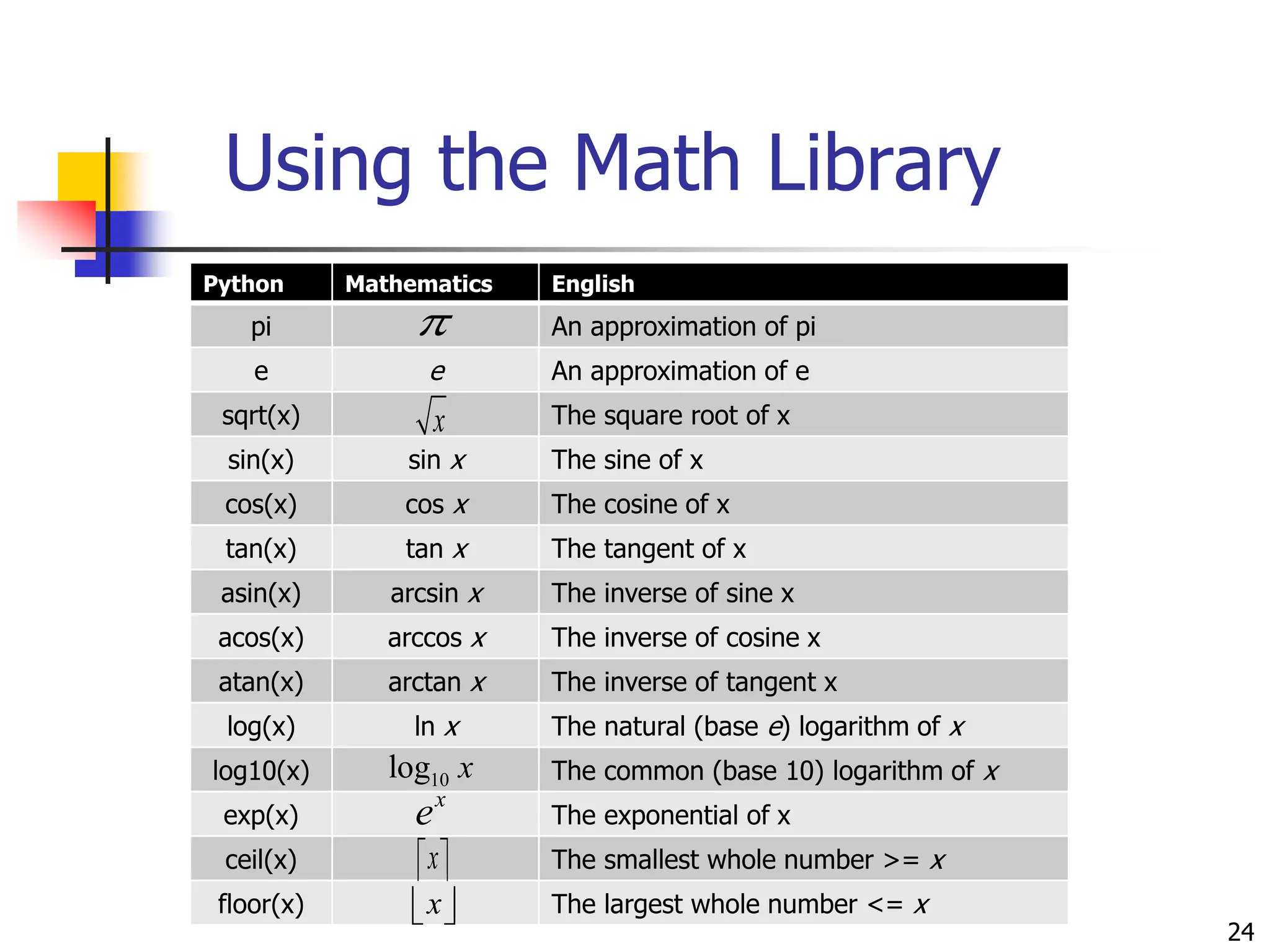
The natural logarithm, often denoted as ln, is the logarithm to the base e, where e is Euler’s number (approximately equal to 2.71828). It is a fundamental concept in calculus and is used to solve a wide range of problems involving exponential growth and decay. In Python, the natural logarithm can be computed using the math module, which provides a straightforward way to perform this calculation.
Using the Python Natural Log Function
To compute the natural logarithm in Python, you can use the math.log function. This function takes two arguments: the number for which you want to compute the logarithm and the base of the logarithm. For the natural logarithm, the base is e, which is the default base for the math.log function. Here is a simple example:
import math
# Compute the natural logarithm of 10
result = math.log(10)
print(result)
This code will output the natural logarithm of 10, which is approximately 2.302585.
Applications of the Natural Logarithm in Python
The natural logarithm has numerous applications in various fields. Here are a few key areas where the Python natural log function is particularly useful:
- Exponential Growth and Decay: The natural logarithm is essential for modeling exponential growth and decay processes, such as population growth, radioactive decay, and compound interest.
- Probability and Statistics: In statistics, the natural logarithm is used in various probability distributions, such as the normal distribution and the exponential distribution.
- Machine Learning: In machine learning, the natural logarithm is used in algorithms like logistic regression and neural networks to model probabilities and optimize loss functions.
- Signal Processing: The natural logarithm is used in signal processing to analyze and filter signals, such as in audio and image processing.
Examples of Python Natural Log in Action
Let’s explore some practical examples of how the Python natural log function can be used in different scenarios.
Exponential Growth
Suppose you want to model the growth of a bacterial culture over time. The population of bacteria can be modeled using the exponential growth formula:
P(t) = P0 * e^(rt)
Where:
- P(t) is the population at time t.
- P0 is the initial population.
- r is the growth rate.
- t is the time.
To find the time it takes for the population to double, you can use the natural logarithm. Here is an example:
import math
# Initial population
P0 = 100
# Growth rate
r = 0.05
# Target population (double the initial population)
P_target = 2 * P0
# Calculate the time to double the population
t_double = math.log(P_target / P0) / r
print(t_double)
This code will output the time it takes for the population to double, given the initial population and growth rate.
💡 Note: The growth rate r should be in the same units as the time t for the calculation to be accurate.
Probability and Statistics
In probability and statistics, the natural logarithm is used to compute the log-likelihood of a probability distribution. For example, consider the normal distribution, which is often used to model continuous data. The probability density function (PDF) of the normal distribution is given by:
f(x | μ, σ) = (1 / (σ * sqrt(2π))) * e^(-(x - μ)^2 / (2σ^2))
Where:
- μ is the mean.
- σ is the standard deviation.
- x is the value.
To compute the log-likelihood, you can use the natural logarithm. Here is an example:
import math
# Mean and standard deviation
μ = 0
σ = 1
# Value
x = 1
# Compute the log-likelihood
log_likelihood = -0.5 * math.log(2 * math.pi * σ^2) - (x - μ)^2 / (2 * σ^2)
print(log_likelihood)
This code will output the log-likelihood of the value x given the mean and standard deviation of the normal distribution.
💡 Note: The log-likelihood is often used in maximum likelihood estimation to find the parameters that best fit the data.
Machine Learning
In machine learning, the natural logarithm is used in various algorithms to model probabilities and optimize loss functions. For example, in logistic regression, the sigmoid function is used to model the probability of a binary outcome. The sigmoid function is given by:
σ(z) = 1 / (1 + e^(-z))
Where z is a linear combination of the input features. To compute the log-likelihood of the sigmoid function, you can use the natural logarithm. Here is an example:
import math
# Linear combination of input features
z = 2
# Compute the sigmoid function
sigmoid = 1 / (1 + math.exp(-z))
# Compute the log-likelihood
log_likelihood = math.log(sigmoid)
print(log_likelihood)
This code will output the log-likelihood of the sigmoid function given the linear combination of input features.
💡 Note: The log-likelihood is often used in logistic regression to optimize the parameters of the model.
Signal Processing
In signal processing, the natural logarithm is used to analyze and filter signals. For example, consider the Fourier transform, which is used to decompose a signal into its frequency components. The Fourier transform is given by:
X(f) = ∫[-∞, ∞] x(t) * e^(-j2πft) dt
Where:
- x(t) is the signal.
- f is the frequency.
- t is the time.
To compute the magnitude of the Fourier transform, you can use the natural logarithm. Here is an example:
import math
# Signal
x = [1, 2, 3, 4, 5]
# Frequency
f = 1
# Compute the Fourier transform
X = sum([x[i] * math.exp(-1j *
Related Terms:
- take natural log in python
- python natural log numpy
- log in python
- math.log python
- natural log ln in python
- numpy natural log function