
In the ever-evolving landscape of software development, the concept of Remote Method Invocation (RMI) has emerged as a pivotal technology. RMI allows an object running in one Java Virtual Machine (JVM) to invoke methods on an object running in another JVM. This capability is crucial for building distributed applications where components can communicate seamlessly across different machines. Understanding RMI and its applications can significantly enhance the efficiency and scalability of your software projects.
Understanding Remote Method Invocation
Remote Method Invocation (RMI) is a Java-based technology that enables objects to communicate with each other across different JVMs. It provides a way to invoke methods on remote objects as if they were local, abstracting the complexities of network communication. This makes it easier to develop distributed applications where different parts of the system can run on separate machines.
RMI operates on a client-server model. The server hosts the remote objects, and the client invokes methods on these objects. The communication between the client and server is handled by RMI, which takes care of the serialization and deserialization of objects, as well as the network communication.
Key Components of RMI
To understand how RMI works, it's essential to familiarize yourself with its key components:
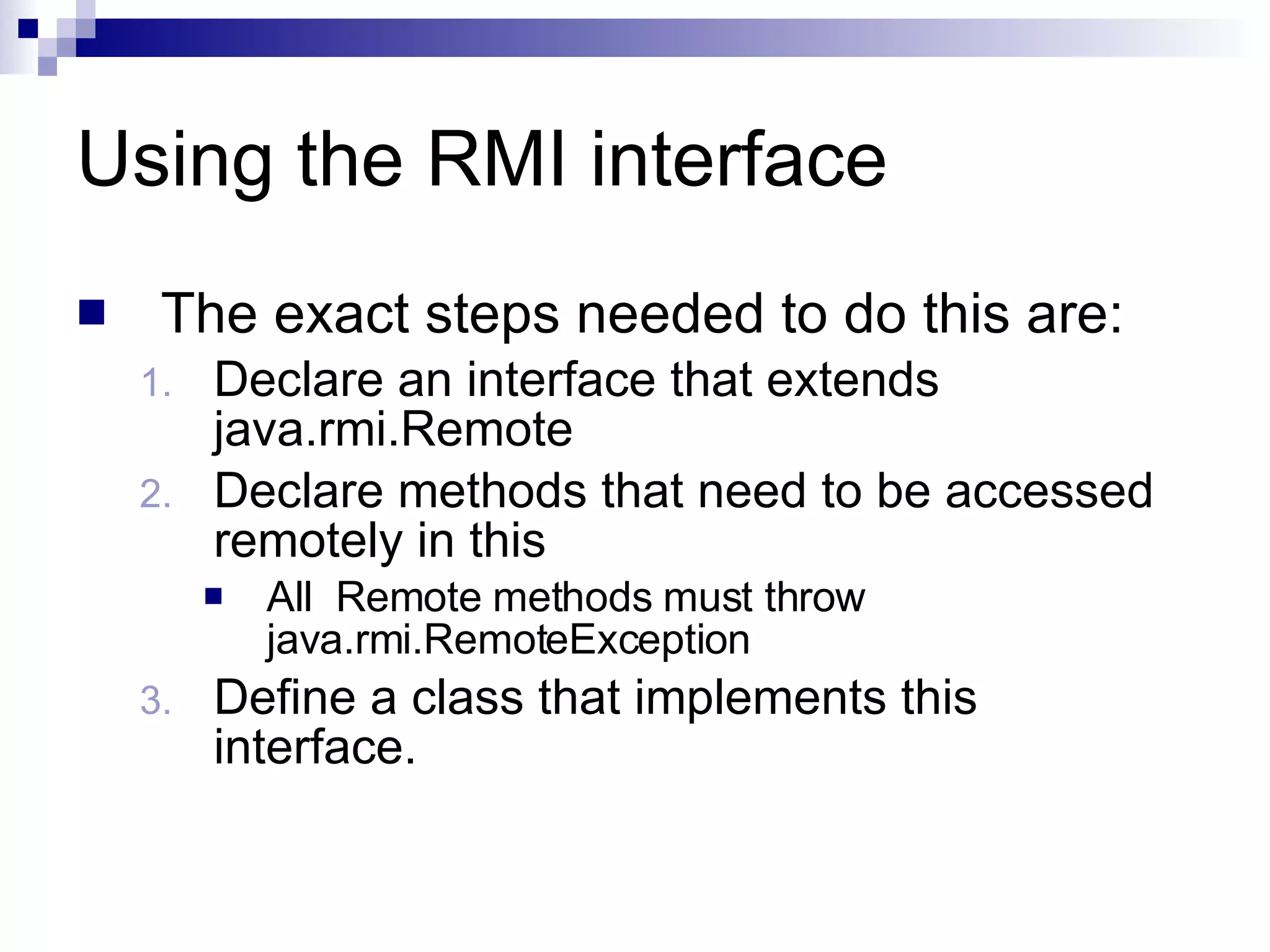
- Remote Interface: This defines the methods that can be invoked remotely. It extends the
java.rmi.Remoteinterface. - Remote Object: This implements the remote interface and extends the
java.rmi.server.UnicastRemoteObjectclass. It provides the actual implementation of the methods defined in the remote interface. - RMI Registry: This is a directory service that allows clients to look up remote objects by name. It is typically used to bind remote objects to names.
- Stub and Skeleton: These are used to facilitate communication between the client and the server. The stub acts as a client-side representative of the remote object, while the skeleton handles the server-side communication.
Setting Up a Simple RMI Application
Creating a simple RMI application involves several steps. Below is a step-by-step guide to help you get started:
Step 1: Define the Remote Interface
Create an interface that extends java.rmi.Remote and declares the methods that can be invoked remotely.
import java.rmi.Remote;
import java.rmi.RemoteException;

public interface Hello extends Remote {
    String sayHello() throws RemoteException;
}
Step 2: Implement the Remote Interface
Create a class that implements the remote interface and extends java.rmi.server.UnicastRemoteObject.
import java.rmi.RemoteException;
import java.rmi.server.UnicastRemoteObject;

public class HelloImpl extends UnicastRemoteObject implements Hello {

    protected HelloImpl() throws RemoteException {
        super();
    }

    @Override
    public String sayHello() throws RemoteException {
        return "Hello, World!";
    }
}
Step 3: Create the RMI Server
Write a server class that creates an instance of the remote object and binds it to the RMI registry.
import java.rmi.registry.LocateRegistry;
import java.rmi.registry.Registry;

public class HelloServer {
    public static void main(String[] args) {
        try {
            HelloImpl obj = new HelloImpl();
            Registry registry = LocateRegistry.createRegistry(1099);
            registry.bind("Hello", obj);
            System.out.println("Server is ready");
        } catch (Exception e) {
            System.err.println("Server exception: " + e.toString());
            e.printStackTrace();
        }
    }
}
📝 Note: Ensure that the RMI registry is running on the server machine. You can start it using the command rmiregistry.
Step 4: Create the RMI Client
Write a client class that looks up the remote object in the RMI registry and invokes its methods.
import java.rmi.registry.LocateRegistry;
import java.rmi.registry.Registry;

public class HelloClient {
    public static void main(String[] args) {
        try {
            Registry registry = LocateRegistry.getRegistry("localhost", 1099);
            Hello stub = (Hello) registry.lookup("Hello");
            String response = stub.sayHello();
            System.out.println("Response: " + response);
        } catch (Exception e) {
            System.err.println("Client exception: " + e.toString());
            e.printStackTrace();
        }
    }
}
Advanced Topics in RMI
While the basic setup of RMI is straightforward, there are several advanced topics and best practices to consider for more complex applications.
Security Considerations
Security is a critical aspect of any distributed system. RMI provides several mechanisms to secure remote method invocations:
- Authentication: Ensure that only authorized clients can access the remote objects.
- Encryption: Encrypt the data transmitted between the client and server to prevent eavesdropping.
- Access Control: Use Java's security manager to control access to remote objects and methods.
Implementing these security measures can help protect your RMI-based applications from unauthorized access and data breaches.
Serialization and Deserialization
RMI relies on Java's serialization mechanism to transmit objects between the client and server. It is essential to understand how serialization works and to ensure that all objects involved in remote method invocations are serializable.
Serialization involves converting an object into a byte stream, which can be transmitted over the network. Deserialization is the process of converting the byte stream back into an object. Both processes must be handled carefully to avoid issues such as class version conflicts and security vulnerabilities.
Performance Optimization
Performance is a crucial consideration for any distributed application. Here are some tips to optimize the performance of your RMI-based applications:
- Minimize Network Latency: Reduce the number of remote method invocations and optimize the data transmitted between the client and server.
- Use Efficient Data Structures: Choose data structures that are efficient to serialize and deserialize.
- Caching: Implement caching mechanisms to reduce the need for frequent remote method invocations.
By following these best practices, you can improve the performance and scalability of your RMI-based applications.
Comparing RMI with Other Technologies
While RMI is a powerful technology for building distributed applications, it is not the only option available. Other technologies, such as Java Remote Procedure Call (JRPC), Java Messaging Service (JMS), and web services, offer different approaches to remote communication. Here is a comparison of RMI with some of these technologies:
| Technology | Description | Use Cases |
|---|---|---|
| RMI | Allows objects to communicate across different JVMs using Java's serialization mechanism. | Distributed applications, enterprise systems, and applications requiring tight integration between components. |
| JRPC | A simpler alternative to RMI that uses HTTP for communication. | Web applications, microservices, and applications requiring lightweight communication. |
| JMS | A messaging system that allows applications to communicate asynchronously using messages. | Enterprise messaging, event-driven architectures, and applications requiring decoupled communication. |
| Web Services | A standardized way of integrating web-based applications using protocols such as SOAP and REST. | Enterprise integration, web applications, and applications requiring interoperability with other systems. |
Each of these technologies has its strengths and weaknesses, and the choice between them depends on the specific requirements of your application.
Future of RMI
As technology continues to evolve, so does the landscape of distributed computing. While RMI has been a reliable technology for many years, new approaches and frameworks are emerging that offer enhanced capabilities and performance. Some of the trends shaping the future of RMI include:
- Microservices Architecture: The shift towards microservices is driving the need for more lightweight and scalable communication mechanisms. Technologies like gRPC and RESTful APIs are gaining popularity in this context.
- Cloud-Native Applications: With the rise of cloud computing, applications are increasingly being designed to run in cloud environments. This requires new approaches to remote communication that can handle the dynamic nature of cloud infrastructure.
- Event-Driven Architectures: Event-driven architectures are becoming more prevalent, where components communicate through events rather than direct method invocations. Technologies like Apache Kafka and AWS EventBridge are leading this trend.
While RMI remains a valuable technology for many use cases, staying aware of these trends can help you make informed decisions about the future of your distributed applications.
In conclusion, Remote Method Invocation (RMI) is a powerful technology that enables objects to communicate across different JVMs. By understanding its key components, setting up a simple RMI application, and considering advanced topics and best practices, you can build efficient and scalable distributed applications. Whether you choose RMI or another technology, the principles of distributed computing will continue to evolve, offering new opportunities and challenges for developers.
Related Terms:
- remote object invocation distributed systems
- remote method invocation in java
- remote method invocation tools
- remote method invocation diagram
- remote invocation in distributed system
- describe rmi with block diagram