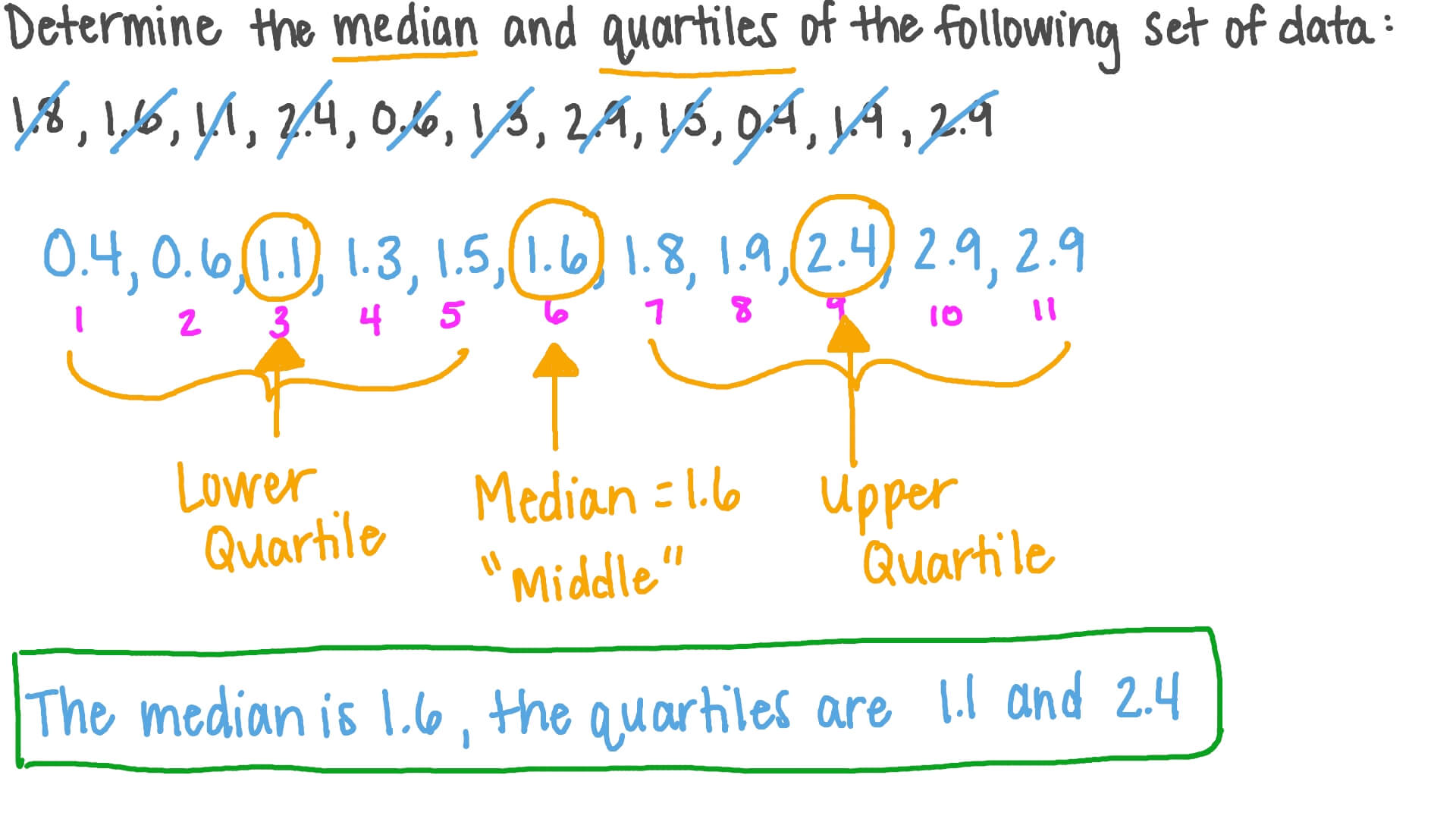

Understanding statistical measures is crucial for data analysis, and one of the key concepts is the upper quartile definition. Quartiles are values that divide a dataset into four equal parts, each containing 25% of the data. The upper quartile, specifically, is the median of the upper half of the dataset, providing insights into the spread and distribution of the data.
Understanding Quartiles
Before diving into the upper quartile definition, it’s essential to grasp the concept of quartiles. Quartiles are statistical values that divide a dataset into four equal parts. They are used to understand the distribution of data and identify outliers. The three quartiles are:
- First Quartile (Q1): The median of the lower half of the data.
- Second Quartile (Q2): The median of the entire dataset, also known as the median.
- Third Quartile (Q3): The median of the upper half of the data, which is the upper quartile definition.
Calculating the Upper Quartile
The upper quartile definition refers to the value below which 75% of the data falls. To calculate the upper quartile, follow these steps:
- Arrange the data in ascending order.
- Find the median (Q2) of the dataset.
- Divide the dataset into two halves at the median.
- Find the median of the upper half of the data. This is the upper quartile (Q3).
For example, consider the dataset: 1, 3, 5, 7, 9, 11, 13, 15, 17, 19.
1. Arrange the data: 1, 3, 5, 7, 9, 11, 13, 15, 17, 19.
2. Find the median (Q2): The median is the average of the 5th and 6th values, which is (9 + 11) / 2 = 10.
3. Divide the dataset into two halves: Lower half: 1, 3, 5, 7, 9. Upper half: 11, 13, 15, 17, 19.
4. Find the median of the upper half: The median of 11, 13, 15, 17, 19 is 15.
Therefore, the upper quartile (Q3) is 15.
📝 Note: If the number of data points in the upper half is even, the median is the average of the two middle numbers.
Interpreting the Upper Quartile
The upper quartile provides valuable insights into the distribution of data. It helps in understanding the spread and identifying outliers. Here are some key points to consider:
- Spread of Data: The difference between the upper quartile (Q3) and the lower quartile (Q1) is known as the interquartile range (IQR). The IQR gives an idea of the spread of the middle 50% of the data.
- Outliers: Data points that fall below Q1 - 1.5 * IQR or above Q3 + 1.5 * IQR are considered outliers. These are values that are significantly different from the rest of the data.
- Skewness: The position of the upper quartile relative to the median can indicate the skewness of the data. If the upper quartile is much higher than the median, the data may be right-skewed.
Applications of the Upper Quartile
The upper quartile definition is widely used in various fields for data analysis. Some common applications include:
- Educational Testing: To analyze test scores and identify students who performed exceptionally well.
- Healthcare: To monitor vital signs and identify patients with abnormal readings.
- Finance: To assess investment performance and risk management.
- Quality Control: To ensure product quality by identifying outliers in manufacturing processes.
Example: Calculating the Upper Quartile in a Dataset
Let’s consider a dataset of exam scores: 45, 50, 55, 60, 65, 70, 75, 80, 85, 90, 95, 100.
1. Arrange the data: 45, 50, 55, 60, 65, 70, 75, 80, 85, 90, 95, 100.
2. Find the median (Q2): The median is the average of the 6th and 7th values, which is (70 + 75) / 2 = 72.5.
3. Divide the dataset into two halves: Lower half: 45, 50, 55, 60, 65, 70. Upper half: 75, 80, 85, 90, 95, 100.
4. Find the median of the upper half: The median of 75, 80, 85, 90, 95, 100 is the average of the 3rd and 4th values, which is (85 + 90) / 2 = 87.5.
Therefore, the upper quartile (Q3) is 87.5.
📝 Note: The upper quartile can also be calculated using statistical software or programming languages like Python and R, which provide built-in functions for quartile calculations.
Visualizing the Upper Quartile
Visualizing the upper quartile can help in better understanding the data distribution. A box plot is a common graphical representation that shows the quartiles and potential outliers. Here’s how to interpret a box plot:
- Box: The box represents the interquartile range (IQR), with the lower boundary at Q1 and the upper boundary at Q3.
- Median Line: The line inside the box represents the median (Q2).
- Whiskers: The whiskers extend to the minimum and maximum values within 1.5 * IQR from Q1 and Q3.
- Outliers: Data points outside the whiskers are considered outliers and are plotted individually.
Here is an example of a box plot:
| Data Point | Value |
|---|---|
| Minimum | 45 |
| Q1 | 60 |
| Median (Q2) | 72.5 |
| Q3 (Upper Quartile) | 87.5 |
| Maximum | 100 |
In this box plot, the upper quartile (Q3) is at 87.5, indicating that 75% of the data falls below this value.
Comparing the Upper Quartile with Other Measures
The upper quartile is just one of several statistical measures used to describe data. Here’s a comparison with other common measures:
- Mean: The average value of the dataset. It is sensitive to outliers and skewed data.
- Median: The middle value of the dataset when arranged in order. It is less affected by outliers and skewed data.
- Mode: The most frequently occurring value in the dataset. It can be useful for categorical data.
- Standard Deviation: Measures the amount of variation or dispersion in the dataset. It is sensitive to outliers.
The upper quartile, along with the lower quartile and median, provides a more robust measure of central tendency and spread, especially in the presence of outliers or skewed data.
📝 Note: The choice of statistical measure depends on the nature of the data and the specific analysis requirements.
In summary, the upper quartile definition is a crucial concept in statistics that helps in understanding the distribution and spread of data. It is widely used in various fields for data analysis and decision-making. By calculating and interpreting the upper quartile, analysts can gain valuable insights into the data and make informed decisions.
Related Terms:
- upper quartile and lower meaning
- upper quartile example
- calculate upper and lower quartile
- how to determine upper quartile
- upper quartile value
- what does upper quartile mean